Solar System – Marcus Chown ****

We’ve all seen the book of the movie, and even films based on theme park rides and computer games. But this could well be the first ever book of an iPad app. Not long ago I had a chance to take a look at the Solar System for iPad app and now we’ve got the book based on it.

Let’s get the downside out of the way first. I can’t be as enthusiastic about the book as I was about the app. Not only does it cost three times as much (before discounts) and threaten serious damage to the wrists from its weight, but also the book can’t compete with the interactive aspects of the app which work so well with this material. I also found that, compared with the iPad version, it was eye-straining to read the relatively small white text on a black background. But even so, there’s plenty to like here.

What we’ve got is a coffee table format book, which feels not unlike a Dorling Kindersley book in the way it uses two-page spreads with a bit of text, some great photographs and various graphics and little factoids to expand on the topic. Some of these can be quite surprising – at one point Brian May from Queen pops up, looking like a fantasy wizard in his doctoral robes, with a comment about his PhD thesis on the movement of solar system dust.

Perhaps to keep the translation from the app simple all the pages are black, which gets a little depressing (I got over my ‘decorate in black’ phase in my teens, thanks), but this is more than compensated for by the lush photography, with some superb imagery of the different components of the solar system. It was interesting to compare one of the pages of the book with the app – I randomly selected ‘Exploring Mars’. The basic text was the same (so as with my main criticism of the app, it could have done with a bit more meat), as was one of the key photographs (which could be panned on the app). The book then has four other photographs while the app has a rather more engaging speeded up video of the Mars rover Spirit in action. On other pages, some of the photographs not in the app were well worth having to expand the general feel of the content, so it wasn’t at all bad in the comparison.

Overall, then, an excellent photographic guide to the solar system and the astronomical basics behind it. Not as much fun as the app, and perhaps could have done with some more text (and fewer black backgrounds for text) – but an excellent book for any astronomy beginner, and would make a great gift.

Hardback:  

Review by Brian Clegg

Tweeting the Universe – Marcus Chown & Govert Schilling ***

My first reaction to this book was that it was going to be an irritating gimmick. How far could you get, after all, putting across complex science in 140 character tweets? However, Marcus Chown is one of the best science writers around, who I trust with my brain (I don’t know Govert Schilling), so I was prepared to suspend disbelief.

I immediately found the style was a little irritating in its conciseness, but it did produce a certain poetic need to really craft all the words that made some of the entries like little works of art. Another concern might be that making the content so short would result in over-simplification, but in most of the entries this wasn’t the case.

There were a few small issues, though. I was a bit worried by the first entry, on Newton’s light and colour work. We come across Newton first using his prism to split light into colours at his home in Woolsthorpe. The trouble is, he bought his first prism at the 1664 Stourbridge fair (near Cambridge), several months before he was exiled home by the plague, and infamously he made a hole to use it in his blinds at Cambridge, not ‘through a slit in the curtains at Woolsthorpe’. It’s not that he didn’t do more work on light in his enforced leave of absence, but it wasn’t the beginning, as the book (or rather its enforcedly compact entries).

Another example of a slight problem probably caused by the condensed text is in the explanation of the tides, which is simplified enough to miss out entirely the main reason that there is a second tide on the far side of the Earth from the Moon.

As I got further in, I did, I confess, increasingly find the choppiness of the prose a bit off-putting. I had to work really hard not to skip over chunks as soon as I had got the gist, to try to keep things flowing. Don’t get me wrong, there’s lots of good stuff in here (particularly some lovely compact cosmology), but I would still much rather read a ‘normal’ book.

One last shame – this was a book that cried out for a section at the back with further reading suggestions for people who have got a taster from what’s on offer. (Each of these could have been tweet length.) There were even loads of blank pages at the back where the recommendations could have gone (I counted 15 empty pages). Certainly this is a bit of fun, and would make a very acceptable gift book, certainly there is some good material in there, but in the end the real thing is not quite as good as the original idea promised. This is not the authors’ fault – they’ve done a great job under the circumstances – just the inevitable limitations of the format.

Hardback:  

Also on Kindle:  

Review by Brian Clegg

Solar System for iPad – Marcus Chown *****

Up to now, popular science software has been the poor cousin to popular science books, but the world is changing, and leading the charge is Apple’s iPad.

Back in the good old days, when science fiction looked into the future, it portrayed people reading information on portable electronic pads. Reading from the screen of a computer has never worked effectively, whether it’s a laptop or a desktop – but the new breed of tablets, with the iPad at the fore, have brought that science fiction dream alive. This is a book plus – and the ‘plus’ has a lot going for it

The Solar System app by experienced popular science author Marcus Chown is still a book. There is enjoyment to be had by just reading linearly through the text. But there is much more to it than that. Key words in the text are highlighted, and a tap brings up a box on them. Each page is illustrated, and usually those illustrations are interactive. So, for instance, on the page about the Earth that shows our planet, you can rotate the globe with a flick of your finger, switch the clouds on and off, zoom in, or flip over to the orrery, flying with the Earth into its position in the solar system.

What is wonderful about the iPad is that this is all so natural. I didn’t need instructions to tell me I could rotate the objects I was looking at, or zoom in on them, I just assumed it would work and it did. Each of the items on that home screen, from the Sun to the Oort cloud has one or more (often quite a few more) pages about it. And the navigation options are considerable. As well as moving through linearly, you can jump from that home screen, use a spatial navigation bar at the bottom, flip to a gallery, examine data – Solar System is excellent, both in terms of content and as a demonstration of why tablets are going to catch on it a big way.

If I had any criticism it would be that the text is perhaps aimed a little too low – I would have liked a little more meat in it – and the text items are short even by Dorling Kindersley standards (which is probably the best print comparison of an app like this). But that simplicity does mean that it is accessible to a wide range of readers, so that perhaps isn’t such a bad thing. There also should have been lots of external linking, which is easy to do transparently from the iPad. I know it’s a pain for the developer, as they would have to keep the links up to date, but it would have made the app even stronger. Oh, and I found the music track by Bjork irritating – but you can skip that.

If you have an iPad, you need a copy of this application. At £7.99/$13.99 it’s good value as an illustrated book, but is so much more. And if you don’t have an iPad, the Solar System app is a strong plus to add to your pros and cons for buying one. Those who argue that a Kindle is just as good for reading books on as an iPad may have a point for traditional text – but a book like this would be inconceivable even with colour e-ink. It is beautiful… and you know you want it!

Downloadable from iTunes

Review by Brian Clegg

Marcus Chown – Four Way Interview

Marcus Chown has recently published Afterglow of Creation, a radical update of a book he wrote in the 1990s about the relic heat of the big bang fireball, which incredibly still permeates the Universe 13.7 billion years after the event.

Why science?

It blows my mind. I’m constantly amazed by how much stranger it is than anything we could have made up.

Why this book?

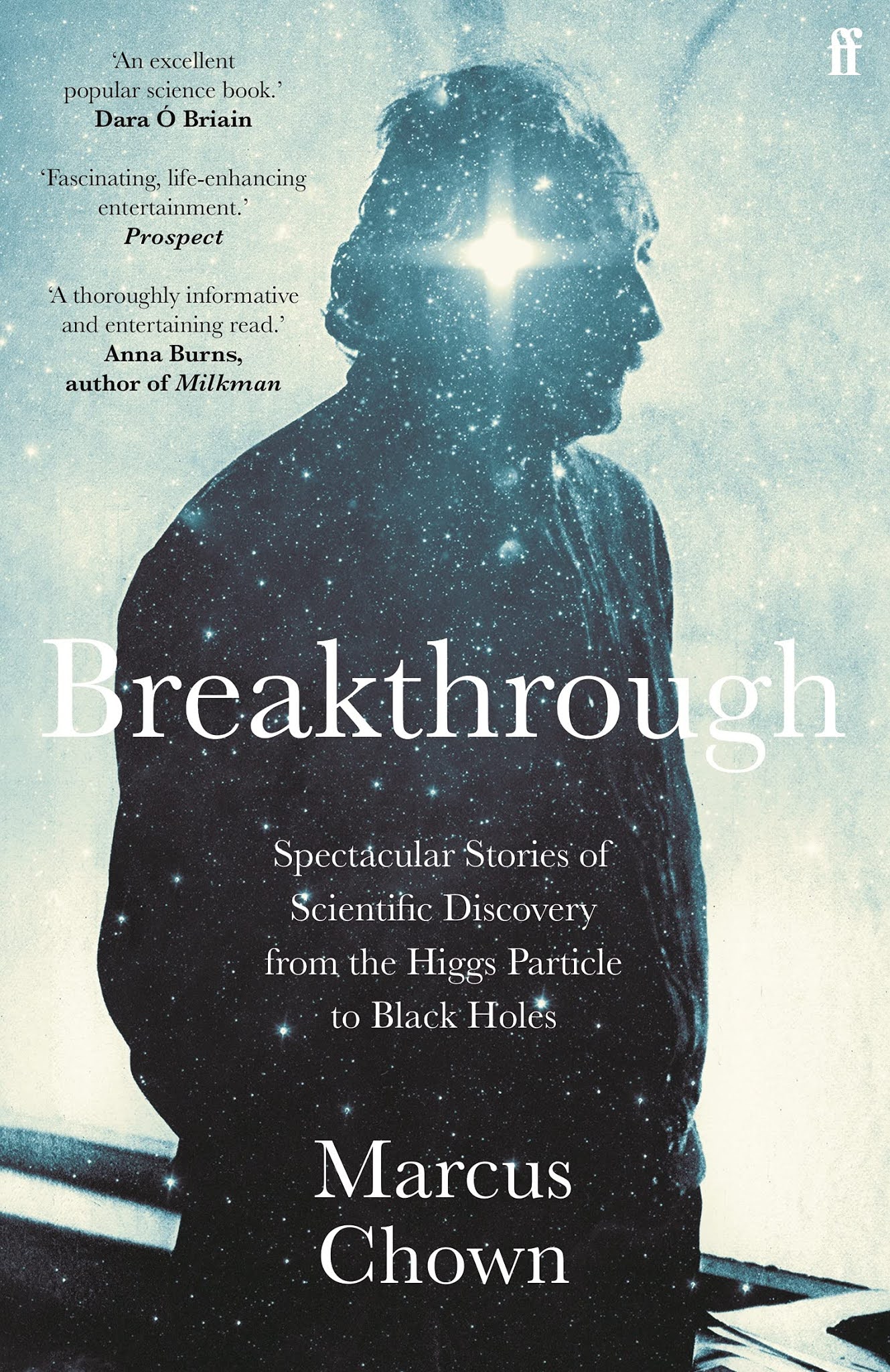
It was my first popular science book and all sorts of wonderful thing happened when it was first published. It was runner-up for the Science Book Prize and the magazine Focus bought about 200,000 copies to give away to its readers as a subscription promotion. The book is about the heat afterglow of the big bang fireball, which, incredibly, still permeates all of space 13.7 billion years after the event, accounting for 99.9 per cent of all the photons in the Universe. For the book, I drove around America, talking to all the people who had been involved in the discovery. Many of them are now dead so the book, I think, is a unique account of a key chapter in the history of science. Why update it? Well, since it was first published, our knowledge of the Universe has been revolutionised by the discovery of the mysterious “dark energy”, the major mass component of the Universe, and by the findings of NASA’s Wilkinson Microwave Anisotropy probe, whose space-based observations of the afterglow of creation are the source of all of our super-precise statements such as “The Universe is 13.7 billion years old”. I am so pleased to see the book out again. I especially like the Faber “retro” cover. And, on the 10th anniversary of his death, I got to write a Foreword about my dad, who had a quite ridiculous amount of faith in me, once insisting I should have won a particular book prize even though I had not entered a book for the prize – in fact, hadn’t even written a book that year! The Foreword meant a lot to me so I was very pleased when Scott Pack, former chief buyer of Waterstone’s said of the book: ‘The wonderful intro alone is worth the cover price. Witty and accessible science.’

What’s next?

The paperback of my book, We Need to Talk About Kelvin: What everyday things tell us about the Universe will be out in September 2010. I am currently writing a sequel to my children’s story, Felicity Frobisher and the Three-Headed Aldebaran Dust Devil, which I enjoyed writing more than anything else I have written, possibly because it was totally silly. My publisher is wanting me to write a new non-fiction book. I can’t say more about it, not because there’s any mystery but because I haven’t yet figured out how to do it!

What’s exciting you at the moment?

The thought that there is some very big idea missing in physics. I mean, we currently have no idea what 96% of the mass of the universe is. What’s more, the main component – the dark energy – has an energy which is 1 followed by 120 zeroes smaller than our best theory of physics predicts. This is the biggest discrepancy between a prediction and an observation in the history of science. I can’t help thinking that all accepted ideas about our universe and our place in it are on the brink of being blown out of the water.

Was the Universe Created by Angels? by Marcus Chown

The discovery that it might be possible to make a universe in the laboratory could have profound implications for the origin of our Universe

The ultimate experiment is about to begin. On a cold, lonely moon, shrouded in purple-pink fog, a sentient ocean marshals the energy of a galaxy and focuses them onto a tiny mote of matter. A hundred billion stars flicker and dim. The air above the ocean sizzles and catches fire. Crushed by stupendous energies, the tiny mote twists and bucks and, with a violent shudder, implodes. Somewhere else–in another space, another time–a searing-hot fireball explodes out of nothingness and begins to expand and cool. The ultimate scientific experiment has produced the ultimate experimental result: the birth of a new universe.

Could our Universe have been born in such a way? According to Edward Harrison, it’s a real possibility. “Our Universe could easily be the outcome of an experiment carried out by a superior intelligence in another universe,” says the British physicist, formerly of the University of Massachusetts at Amherst.

Why suggest such an outlandish thing? Because it sheds light on a deep puzzle: why the laws of physics appear “fine-tuned” for our existence. Surprisingly, even slight deviations in the laws would result in a universe devoid of stars and life. If, for instance, the force of gravity were just a few percent weaker it could not squeeze and heat the matter inside stars to the millions of degrees necessary to trigger sunlight-generating nuclear reactions. If gravity were only a few percent stronger, however, it would heat up stars, causing them to consume their fuel faster. They would not exist for the billions of years needed for evolution to produce intelligence.

This kind of fine-tuning turns out to be widespread. One possible explanation is that the Universe was “designed” by God. Some scientists accept this. “Unfortunately, it terminates further scientific enquiry,” says Harrison. The other possibility is that the Universe is the way it is because, if it wasn’t, we would not be here to notice. According to this topsy-turvy reasoning, known as the “anthropic principle”, it is hardly surprising that we find ourselves in a universe which is fine-tuned for the existence of galaxies, stars and life. We could hardly have evolved in a universe that was not!

The anthropic principle leads to the idea that our universe is one of countless others. In each universe of this “multiverse”, forces like gravity have different strengths. An unavoidable consequence, however, is that most universes lack the special conditions needed for the birth of galaxies, stars, planets and so on. “There will be countless lifeless universes,” says Harrison. “This is waste on a truly cosmic scale.”

But in cosmology, as in politics, there may be a third way. According to Harrison, the multiverse could be far from a wasteland. It could be dominated by universes with galaxies and stars and life. The prerequisite is that life-bearing universes have a special ability: the ability to reproduce. Specifically, Harrison is suggesting that intelligent life actually makes new universes. “If so, then in offspring universes which are fit for life, new life evolves to a high level of intelligence, then creates further universes,” says Harrison.

In Harrison’s scheme, dubbed the “natural selection of universes”, the laws of physics most suited for the emergence and evolution of life are naturally selected by life itself. The origin of our Universe is explained. It was created by super-intelligent beings living in another universe!

If Harrison is right, the fine-tuning of the laws of physics has two possible explanations. New universes could inherit the characteristics of their cosmic parents as children inherit the characteristics of their human parents. Small “genetic variations” in the laws between generations would ensure new universes were not carbon copies of their predecessors. It follows that since the parent of our Universe was fine-tuned for life and similar to our own–if it wasn’t, life would never have arisen in it to make our Universe–our Universe must also be fine-tuned. Another possible explanation for the fine-tuning is that the makers of our Universe actually engineered our Universe to have laws that promoted the evolution of intelligent life.

According to Harrison, the mystery of why the Universe appears designed for life has a straightforward solution: at a fundamental level it was designed for life. However, and this is Harrison’s novel twist, it was designed not by God–a Supreme Being–but by superior beings. Angels, if you like! “Intelligent life takes over universe-making business,” says Harrison. “Consequently, the creation of the universe drops out of the religious sphere and becomes amenable to science.”

Crucial to Harrison’s reasoning is the assumption that it is actually possible to make a universe. Bizarre as it seems, this is not science fiction. The recipe was discovered independently around 1980 by Alexei Starobinsky in Russia and Alan Guth in America. In their “inflationary” picture, our Universe “inflated” from a super-dense “seed” of matter, perhaps only a thousandth of a gram. This prompted Guth to suggest that a universe might be made in the laboratory. Simply take a seed of matter and squeeze it to the extraordinary density that once triggered the inflation of our Universe. This will make a black hole. However, according to Guth, the super-dense interior will inflate–not in our universe, but in a bubble-like space-time connected to our own by the “umbilical cord” of the hole. This cord is unstable. When it snaps, a baby universe will be born! “The practical details are not important,” says Harrison. “The important thing is that if beings of our limited intelligence can dream up wild, yet seemingly plausible, schemes for making universes, beings of much higher intelligence might know theoretically and technically how to do it.”

Recreating the conditions of the first split-second of the Universe is way, way beyond our capabilities. But it may not be impossible. “It’s conceivable that more intelligent beings–perhaps even our own descendants in the far future–might possess not only the knowledge but also the technology to build universes,” says Harrison.

But why would they want to? One possibility, says Harrison, is simply to see what happens. There may be some beings so advanced that their children make universes in the same way human children make figures out of plasticine. Another possibility, says Harrison, is that an advanced civilization, out of a spirit of altruism, might make new universes which are ever more hospitable for life.

The observable Universe contains about 10 billion galaxies. If, during the lifetime of each, a single civilisation emerges which makes a new universe–a modest figure considering our Galaxy has 200 billion suns–then our Universe reproduces 10 billion times. Furthermore, if intelligent life in each galaxy of each daughter universe repeats the ultimate experiment just once, the result is 10 billion times 10 billion granddaughter universes. This rate of reproduction puts a flu virus to shame! Life-bearing universes could very quickly come to dominate the multiverse.

Einstein famously said: “The most incomprehensible thing about the Universe is that it is comprehensible.” According to Harrison, the explanation is that it was created by comprehensible beings–beings far in advance of us but basically like ourselves. Intelligent but also intelligible. They made our universe to be like theirs, and their universe was in turn understandable. After all, they had to have the understanding to manipulate it and make a new universe.

A difficulty with Harrison’s vision is that, if our Universe was created by superior beings in another universe and theirs in turn was created by superior beings in an earlier universe, and so on, who or what created the first universe? One possibility, admits Harrison, is God. It seems a weak admission. However, Harrison distinguishes between his idea and the religious view. “In my scheme, God starts things,” he says. “Thereafter, superior beings take over the creation of further universes.” Another possibility is that in the beginning there was a large ensemble of universes, each with its own random variant of the laws of physics. Most of the universes were dead and uninteresting. But, by chance, the conditions in at least one—the intelligent “mother universe”–were right for life. “Thereafter, intelligent universes come to dominate the ensemble since they alone reproduce,” says Harrison.

But if a Supreme Being made the first universe, who or what made the Supreme Being? And, if everything began with a mostly-dead ensemble of universe containing the intelligent mother universe, how did that come about? “Perhaps the supreme being occupied another universe created by an even higher form of intelligence, and perhaps the initial ensemble consisted of botched and bungled creations by a sorcerer’s apprentice in another universe!” says Harrison.

One thing follows automatically from Harrison’s vision. If humanity avoids destruction and survives into the far future, one day our descendants will have to make an important decision: whether or not to become parents!

Marcus Chown’s book, The Universe Next Door: Twelve mind-blowing ideas from the cutting edge of science, is published by Headline.

We need to talk about Kelvin – Marcus Chown *****

The things we react to first about a book are its cover, its title and its author. This one has an eye-popping cover in a very 2008/9 comic style, a title that really grabs the attention (even if the pun is a bit wince-making) and an author that immediately gives you the reassurance that you are going to have a good time – Marcus Chown is one the most consistently entertaining popular science writers in the business.

For entertainment value, and driving pace, Kelvin never lets the reader down. From the start we are bombarded with amazing facts, driven by Chown’s very effective idea of taking everyday aspects of human existence and exploring the exciting science that lies behind them. So, for instance, the partial reflection through a night-time window leads on to the consideration of the quantum theory of light and much more. Later on, we discover more about the nature of atoms and heat, thermodynamics and cosmology.

Chown’s great strength is that he can counter the QI glaze effect. On the TV show QI, when they occasionally have a panellist with a science background, the other competitors start to glaze over whenever that person starts on about a science subject. They visibly drop off and lose interest. It’s very easy to present something like the Pauli exclusion principle that is at the heart of subatomic physics in a way that would put the reader to sleep as well – but Chown makes it interesting and makes it seem very logical.

A lot of the content is fairly familiar ground if you regularly read popular science books, but that doesn’t stop it being interesting even if it is familiar – and for many readers there will be much that is new. Even for the popular science enthusiasts there will be some surprises, for example the shock revelation that 99 per cent of astronomers get the answer to Olber’s paradox -why is the night sky black, rather than full of stars? – wrong. And I rather like the way he finishes the book on a very open topic – why we aren’t being constantly visited by aliens.

Inevitably there are a few small gripes. The book doesn’t have any illustrations or diagrams – this is usually fine, and Chown does a great job of painting a picture with his words. But there were a couple of occasions, particularly when describing the difference between fermions and bosons, when a diagram or two really would have helped untangle what was being said. Another problem I had is that to make the material approachable he is very definitive. You would think there was no possibility of alternative theories to some of the concepts mentioned. And very occasionally his cracking pace gets in the way of understanding. When he says that light being produced by an electron is a bit like a 40 tonne truck emerging from a matchbox, I want to know a bit more – but he’s already on to the next thing. But these are all very minor worries.

All in all, a great idea for a book, a very enjoyable read and a strong addition to the Chown oeuvre.

Hardback:  

Review by Brian Clegg

The Never-Ending Days of Being Dead – Marcus Chown ****

There’s something deeply satisfying about the title of Marcus Chown’s book – it really catches the attention. This isn’t one of those collections of little scientific snippets – you know the sort of thing, the type of book that asks if penguins’ feet freeze – though it could be mistaken for one thanks to the look of the cover. Although it is a collection of different scientific theories, it is both a much deeper and more mind-boggling book than the “questions answered” type. It is subtitled “dispatches from the frontline of science”, and that frontline is the interface between scientific ideas and the deepest questions of the universe. For Douglas Adams fans, this is real Deep Thought territory.

Chown takes off with the relatively familiar but still mind boggling concept that our universe could be but a single bubble amid a myriad variant universes, so many in fact that there’s one out there where Elvis lives, and another identical to this, except you aren’t reading this review right now (spooky, but irritating behaviour by that other you). From there he moves on to Stephen Wolfram’s much attacked but still fascinating idea that the whole universe could be the outcome of a surprisingly simple computer program. Elsewhere you’ll find the really strange bits of the quantum universe, Chaitin’s amazing number Omega (which, Chown claims, is the real life equivalent of Douglas Adams’ 42), the chances of meeting up with an alien (and what an alien culture’s communications might be like), finally reaching the title story. This last one is the weirdest of the lot. The idea is that by the end time of the universe, there will be beings who are so technologically advanced that they can re-engineer the universe in a special way that will enable the end times to stretch for ever (subjectively), and that they will run a computer simulation so clever that we will all wake up after death in this electronic, everlasting heaven.

To be honest, I found this last topic a little tedious just because it was piling so much speculation upon speculation as to be practically meaningless. But the majority of the material in here is cracking stuff. Unlike Chown’s The Universe Next Door, although the sections are independent to the extent that some of the ideas contradict each other, and there’s an occasional slight overlap of information, there isn’t the same feeling that this is a collection of articles strung together – it reads as a book.

Throughout, Chown’s writing is superbly approachable. Over the years he has developed a laid-back tone well suited to getting across the most evilly complex science in an approachable way. The only slight concern here is that this can result in throwaway lines that don’t hold up to close scrutiny. At one point he says that Ockham’s razor is “invariably is true.” If this were the case there wouldn’t be a lot of point doing experiments, you’d just pick the simplest explanation. In fact a fair amount of the book is spent showing us scientific ideas that are anything but the simplest, but may be true. Another slight irritation is that, presumably in another attempt to be less frightening, instead of writing powers in the usual way, for example 108, he writes 10^8, as if entering it into a calculator. I find this much harder on the eye.

The only other problem here is the difficulty of handling such complex and far out concepts in a popular science book. Almost inevitably this leads to some statements that aren’t justified by the context that can be provided. For example, the first chapter states that in the model of an inflationary universe containing vast numbers of bubble universes, each seeded by a random start, because the overall universe is “effectively infinite in extent,” every possible arrangement must occur somewhere. (Hence Elvis and the other you, not reading this review.) This is flawed on two levels. Firstly there is an infinite (literally) difference between near-infinite and infinite. However many bubbles are postulated, you can take that number away from infinity and still have infinity left. You can’t apply arguments from infinity to a finite number. Secondly, even if there were an infinite set of bubble universes, it doesn’t follow that they provide every possible variant of the “real” universe – you could still have an infinitely varied set, none of which faintly resembled our own. This follows from the nature of quantum particles, each of which has properties that are effectively boundless, so in principle you could have an infinity of universes each featuring just one particle.

Another example of this difficulty that arises when you move from a complex science to a simple description arises in the last chapter, when talking about simulating the universe on a computer. We are told that “a perfect simulation of reality is a possibility.” If this were true, the simulation would have to be able to predict when a radioactive particle was about to decay – but this is definitively unpredictable. All we can predict is the probability of it occurring. According to quantum theory there is no hidden piece of information that will tell when it actually is going to decay, so such a simulation is beyond possibility.

This sort of problem is pretty well inevitable, though, with this kind of material, and it doesn’t really matter. What’s important is that this book opens up some of the leading edge physics thinking, explains lots of hot science superbly well, and will get readers thinking and talking about it, even if they don’t agree with it. Perhaps especially if they don’t. And that can’t be a bad thing.

Paperback:  

Review by Brian Clegg

Marcus Chown’s The Never-ending Days of Being Dead is an energetic romp through the big ideas of leading-edge physics. There is enough technical detail to make the ideas credible, but not so much that they are incomprehensible; the prose is chummy; and the storyline is well-stocked with heroic renegade scientists leading their conservative colleagues into new and mind-bending realms. Chown’s aim is to find the most wacky, exciting answers to the deepest questions that physicists pose. One problem with this approach is that the wackiest, most exciting answers are not necessarily the true ones, and Chown’s enthusiasm for oddball science could sometimes benefit from less breathless awe and more reasoned scepticism. But it is hard to be rigorous and rollicking at the same time, and Chown achieves a pretty good balance between the two.

Breathless awe is no doubt an appropriate response to some of the topics that the book covers. The section titles tell us that Chown is not afraid of deep water: Part One is about The Nature of the Universe; Part Two concerns The Nature of Reality; and Part Three is modestly titled Life and the Universe. In 11 distinct chapters the book describes the most recent twists on big themes in physics and cosmology: the evolution of our (and other) universes; the search for alien intelligence; how to explain mass in its different forms; why we experience time as a “flow” from past to present; where the laws of physics come from; whether life can survive forever in the universe; and why ordinary objects behave differently from very small objects.

The questions are big and the answers unusual, and Chown is not afraid to say so. Occasionally he sounds more like a science publicist than a science expositor. If a discovery is not “profound”, “crucial”, “fascinating and intriguing”, “earth-shattering”, or “deeply connected” to some other discovery, it is “deeply, deeply subtle.”

Fortunately, Chown’s gift for superlatives is matched by his gift for drawing out more intriguing implications of scientific theories. It is truly odd and surprising to think there are a large number of other universes in which contain exact replicas of ourselves; or that at the end of the universe we will find ourselves reborn in a computer program. Other scenarios that Chown asks us to consider are that the “Creator” of our universe has encoded the laws of the universe in the cosmic background radiation; that the laws of physics arose because they are the laws that automatically apply to an empty universe; and that if our perceptive organs were set up differently, we might experience (say) the past as present, and vice versa.

If one takes Chown’s introduction literally, the point of the book is just to raise these intriguing possibilities. “I think this is the nature of science at the leading edge. It is ultimately about down-to-earth things we all care about — Where did we come from? Where did the universe come from? What the hell are we doing here?”

But to Chown’s credit and the reader’s pleasure, the book is much more about the process of arriving at the intriguing conjectures, rather than the conjectures themselves. Consider Steven Wolfram (a recurring hero in the book) and his idea that the physical world is best modelled by computer programs, not mathematics. In his chapter on Wolfram Chown eases the reader step by step into Wolfram’s unusual world, pointing out the pitfalls as well as the milestones along the way. For example, Wolfram thinks a program of a certain kind — “a cellular automaton” — is not just good at describing the natural world; it actually is the natural world. So Chown has the daunting task of making sense, for the general reader, of a universe that is a 3D grid of nodes and cells, with the each cell updating periodically depending on what its surrounding cells are doing. He makes a brave attempt, honing in on one specific problem with the theory, and Wolfram’s answer to it: how all cells in this giant array can update at the right time.

Chown is not afraid to say that Wolfram’s theory is a fringe idea. Nor is he afraid to say, when the occasion demands it: “this is a leap of faith”, or “this may seem a little woolly”. He assumes the reader is ignorant, but not that he is gullible. The result, in this and other chapters, is popular science that tells intriguing stories about why radicals believe what they do.

A conjecture has no intrigue if it makes no sense to the reader. So it’s a good thing that Chown’s story-telling is backed up by some skilled pedagogy. One of the most abstract chapters, on how physical laws rise out of symmetries, is a case in point. Chown starts with some history: in 1918 the German mathematician Emmy Noether realised that some fundamental physical laws — like the conservation of energy and of angular momentum — can be derived just from some basic symmetries — like the fact that physical laws are the same at all times, and in all directions. But how is this so? Chown gives an entry-level analogy. It’s like watching telegraph poles from the window of a car, he says: there’s a link between the telegraph poles all being the same distance apart, and the car having an unchanging momentum. So far so good. A second analogy pushes the reader up a level. Symmetries in space and time lead to laws, but so do symmetries in “space and time taken together.” A phrase like that is likely to shake the reader a bit, but Chown has a supporting metaphor to prop the reader up: he links the co-ordinates of space-time to co-ordinates on a normal map. Next, a second series of analogies takes the reader from centrifugal force (not a real force, as we all know); to general relativity (where gravity is not a real force — it just makes sure the laws of physics are the same for people who accelerate at different rates); to quantum mechanics and gauge theory (where electromagnetic forces make sure that the laws of physics stay the same when each point of a quantum wave rotates by a different amount).

In these passages, Chown doesn’t just use analogies: he uses the product of one analogy as the premise for next. The reader’s reward for climbing these analogical ladders is to understand what Chown means when he says something like: “Yet it turns out that everything Maxwell struggled to understand for more than a decade is merely the consequence of a simple symmetry principle: the laws of motion for a quantum particle must be the same under arbitrary rotations in complex space at different points in space.” This is a remarkable fact about physics — if you know what it means. We are lucky to have someone like Chown who can describe what it means.

Chown’s account of symmetry, general relativity, and gauge theory are of course wildly simplified. Take a closer look and the rungs of the ladder look less solid. For example, no doubt there is a link (as Chown says) between telegraph poles all being the same distance apart, and a car having an unchanging momentum. But isn’t this just another way of saying that speed is proportionate to distance travelled? And if so, does the example really cast any light on symmetry? To tell the reader what symmetry really means, Chown would need to answer these questions and many more like them. But at least he brings the reader to the point where the questions make sense.

Conclusion: if you know nothing about physics or maths, do read this book. You will learn and understand more than you thought you could learn or understand, and more easily. If you learnt some maths or physics at school or university, read this book even if you have no taste for popular science. You may learn something new; can admire Chown’s clever, colourful, accessible, explanations; and should enjoy your own attempts to poke holes in them.

Review by Michael Bycroft

Quantum Theory Cannot Hurt You – Marcus Chown *****

Some while ago, one of www.popularscience.co.uk’s readers asked for some advice. He’d read our dismissive review of The Dancing Wu Li Masters and wondered if we could recommend an alternative as a good introduction to the amazing world of quantum theory. To be honest, we struggled. There are some reasonable books around, but they’re mostly quite dated, and none of them are top notch popular science. Luckily, though, Marcus Chown has come to our aid with Quantum Theory Cannot Hurt You, simply the best and most readable overview of the quantum world, with a great high level overview of general relativity thrown in as a bonus.

Right from the beginning you know that Chown is going to make this an interesting ride. He hits you between the eyes with some of the mind-boggling consequences of quantum physics and relativity, then takes the reader spiralling into the sub-atomic world to explore the nature of matter and the seemingly impossible behaviour of quantum particles that insist on being in more than one place at a time, in jumping over insuperable barriers and in making impossibly complex calculations trivial. All the half-familiar armoury of the quantum world, from Heisenberg’s Uncertainty Principle, to superfluids, slots into place as step-by-step Chown builds a readily comprehensible picture of what is going on all around us, if only we could see into the world of individual atoms and photons of light.

Barely pausing for breath, Chown then does a Matrix-like blast into space, going from concentrating on the very small to the universal implications of relativity. Building steadily on the critical assumption of the unchangeable speed of light (in a vacuum), we find E=mc2 popping into place, and the rapid transition from the strange concepts of special relativity to the universal impact of general relativity and its implications for gravity. Chown eloquently demonstrates that “the force of gravity does not exist” in a similar way to the realization the centrifugal force does not exist. Each is just the tendency of objects to carry on moving the same way unless forced to do otherwise by being restricted by the environment about them, rather than a true force.

By the end of the book, quantum theory and relativity will no longer seem a mystery. You might not be an expert – inevitably some of the topics are glossed over with some of the subtlety slightly distorted, but the big picture is just right. It’s interesting that Chown manages this without using any of the over-fancy diagrams plaguing many recent books on these subjects – he uses great word pictures to do away with the need for illustrations.

If there’s any moan here it’s the bit of cosmology that seems rather tacked on in the last chapter. While relativity is relevant to theories of how the universe has expanded, cosmological concerns are something of a tangential topic, and we end up with very quick overviews of the big bang, dark matter, inflation etc. which don’t feel quite as superb as the rest of the book. I’d rather have lost these and had more detail on some of the more central topics. But that is a very small point.

Overall, anyone who is baffled by quantum theory or relativity – anyone who wants a guide that doesn’t assume you know anything, but doesn’t patronize – should run, not walk, to the bookstore and lay their hands on Quantum Theory Cannot Hurt You.

Paperback:  

Kindle:  

Review by Brian Clegg

Afterglow of Creation – Marcus Chown ****

This is the story of the cosmic background radiation – the ‘afterglow’ of the Big Bang in which the Universe was born – and how it was discovered.

Chown brilliantly weaves a tale of the search for the origins of the Universe, from the early years of cosmology (remarkably less than 100 years ago) to the flight of the COBE satellite and its crucial discovery.

This is the supreme detective story of cosmology. It begins in 1924 with Hubble’s discovery of galaxies and continues through to the 1992 discovery of extremely distant remnants of the Big Bang, ripples in space/time that provide a tantalising echo of the first beginnings.

Like all the best popular science, the book is as much about the people involved as the science itself. Afterglow finishes with a description of the resulting publicity and wrangling among team members who felt that one team leader, George Smoot (who had described a “map” of the ripples as “like seeing the face of God”), was hogging the spotlight. It’s a very relevant reminder that scientists may attempt to be objective in their work, but remain human.

Now newly republished in an updated edition, this book was nominated the prestigious Rhone Poulenc prize for science writing (now the Royal Society Prize).

Paperback:  

Kindle:  

Review by Brian Clegg

The Universe Next Door – Marcus Chown *****

The universe is a strange place. A very strange place. And Marcus Chown’s book is a great way to find out just how amazingly, mind-bogglingly, wonderfully strange it is.

By following some of the more extreme scientific speculations, Chown leads you on a fairyland tour of the remarkable possibilities of our universe. These vary from the near-mundane – that a pencil stood up on its point actually falls in all directions at once (or it would if nothing interfered with it) – to the out-and-out bizarre thought that the universe might have been intentionally created by super-intelligent beings.

This isn’t a Physics of Star Trek type book, where real science is applied to science fiction stories (though Chown does use a number of quotes from science fiction), but valid (if sometimes not widely accepted) speculation about the nature of the real universe.

The only slight flaw is that the book does read slightly like a number of articles that has been strung together – there’s a lack of consistent linking between sections – but that’s a minor complaint because the whole thing is a delight (and not too long, unlike certain popular science books we could name). A gem.

Paperback:  

Review by Brian Clegg